How to Cycle an Aquarium Fast: 4 Methods Compared
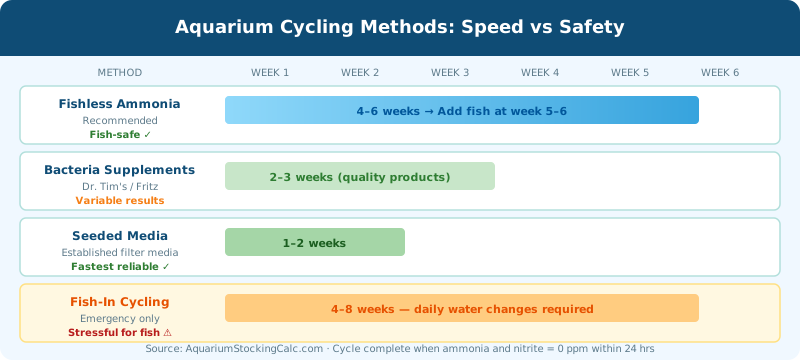
Fishless cycling takes 4–6 weeks but is safest for fish. Seeded media can cycle a tank in 1–2 weeks. Here is how each method works and when to use each one.
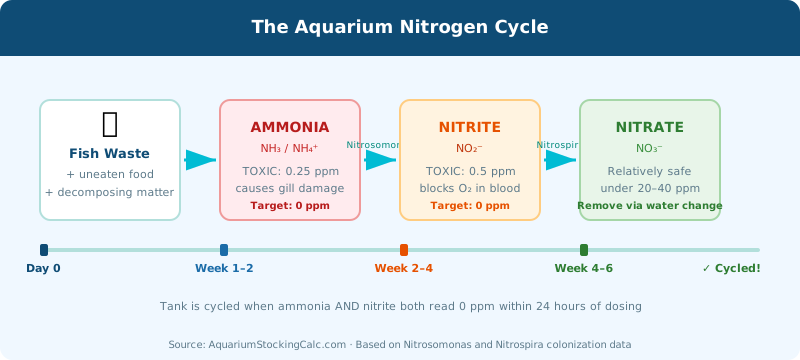
Before you can add fish to a new aquarium, it needs to go through the nitrogen cycle, the process by which beneficial bacteria establish colonies in your filter media that convert toxic ammonia to safer nitrate. Without this, fish die from ammonia poisoning within days.
There are four main methods to cycle a tank, ranging from 1 week to 6 weeks depending on your approach and what materials you have available. Here is how each works.
Method 1: Fishless Cycling with Pure Ammonia
Time: 4–6 weeks | Cost: $5–$10 | Difficulty: Easy
The cleanest and most reliable method. You dose the tank with pure ammonia (no surfactants; use Dr. Tim's Ammonium Chloride or pure household ammonia with no additives), feed the developing bacteria, and add fish only after both ammonia and nitrite consistently return to 0 ppm within 24 hours.
How to do it: 1. Set up the tank with filter, heater, and dechlorinated water. No fish. 2. Dose ammonia to 2–4 ppm. Test with a liquid kit. 3. Every 1–2 days when ammonia drops below 1 ppm, redose to 2 ppm to keep bacteria fed. 4. Around week 2–3, nitrite will appear (bacteria processing ammonia to nitrite). This is progress. 5. Around week 4–5, nitrite will start dropping as Nitrospira bacteria establish. 6. The cycle is complete when you dose to 2 ppm ammonia and both ammonia AND nitrite read 0 ppm 24 hours later. 7. Do a 50% water change to flush accumulated nitrate, then add fish.
Advantages: Fish-safe, thorough, well-understood. No fish are harmed.
Disadvantages: Takes 4–6 weeks. Requires patience and regular testing.
Read our nitrogen cycle explained for the biology behind why this works.
Method 2: Bacteria Supplements (Bottled Bacteria)
Time: 1–4 weeks | Cost: $15–$30 | Difficulty: Easy
Bacteria supplement products (Tetra SafeStart Plus, Seachem Stability, Dr. Tim's One and Only, Fritz Turbo Start) claim to contain live nitrifying bacteria that jump-start the cycle. Results vary significantly by brand and product freshness.
Dr. Tim's One and Only and Fritz Turbo Start 700 consistently outperform in hobby testing; both contain Nitrospira-dominated bacterial cultures that are well-matched to aquarium conditions. Tetra SafeStart has a decent track record. Generic "beneficial bacteria" products from budget brands are often ineffective.
How to do it: 1. Set up tank fully with dechlorinated, temperature-stable water. 2. Shake bottle thoroughly, add entire bottle to filter intake or directly into tank. 3. Immediately add a small ammonia source (2 ppm liquid ammonia or a pinch of fish food daily). 4. Test ammonia and nitrite every 2 days. With a quality product and correct dosing, some tanks cycle in 1–2 weeks. 5. Do not do water changes during cycling; this will remove the bacteria. 6. Add fish when ammonia and nitrite read 0 ppm for 2+ consecutive days.
Advantages: Can cut cycling time to 1–2 weeks with quality products. Easy to use.
Disadvantages: Inconsistent results. Products have variable shelf life (bacteria die at room temperature). Some products claim results that do not consistently materialize.
Method 3: Seeded Media from an Established Tank
Time: 1–2 weeks | Cost: Free (if you have access) | Difficulty: Easy
The fastest reliable method. Transferring established filter media, gravel, or décor from a healthy, disease-free cycled tank to your new tank transplants a mature bacterial colony. Your new tank effectively borrows someone else's cycle.
What to use (in order of effectiveness): 1. Filter media (ceramic rings, bio-balls, sponge): carries the highest bacterial density 2. Substrate (a handful of established gravel or sand) 3. Décor (rocks or wood from an established tank)
How to do it: 1. Get media from a trusted, disease-free source (fish store display tanks, a fellow hobbyist's established tank). 2. Place directly into your new filter. Do not rinse or let it dry out. Bacteria die quickly when exposed to air. 3. Add a small fish load (25–30% of your eventual target) immediately. 4. Test daily. Most tanks set up this way show 0/0 ammonia/nitrite within 1–2 weeks.
Advantages: Fastest reliable method. Works nearly every time if media is genuinely established.
Disadvantages: Requires access to a disease-free established tank. Carries some disease transmission risk (ich, parasites can transfer with media).
Method 4: Fish-In Cycling (Emergency/Unavoidable Situations)
Time: 4–8 weeks | Cost: Water conditioner ($15–$20) | Difficulty: Demanding
If you already have fish in an uncycled tank (a common mistake), fish-in cycling manages ammonia levels while the cycle establishes. It works, but it is stressful for fish and requires very active management.
How to do it: 1. Purchase Seachem Prime immediately. Dose at full concentration every 48 hours. Prime detoxifies ammonia and nitrite for 48 hours without interfering with the cycle. 2. Test ammonia and nitrite daily. Keep ammonia below 0.5 ppm and nitrite below 0.5 ppm. 3. Do 25–40% water changes whenever ammonia or nitrite approaches 0.5 ppm. 4. Feed minimally: once daily, only what fish consume in 2 minutes. Uneaten food spikes ammonia. 5. Optionally add bacteria supplements (Dr. Tim's, Fritz) to accelerate cycling. 6. Continue until both readings hold at 0 ppm for 5+ consecutive days without water changes.
Advantages: The only option if fish are already in an uncycled tank.
Disadvantages: Stressful for fish. Requires daily testing and frequent water changes for 4–8 weeks. Higher risk of fish losses than fishless cycling.
Which Method Should You Use?
- Planning a new tank from scratch: Fishless cycling with pure ammonia. Thorough, reliable, no fish harmed.
- Want it faster and have access to established media: Seeded media method. Can cycle in 1–2 weeks.
- Want it faster but only have bottles: Dr. Tim's One and Only or Fritz Turbo Start 700. 2–3 week cycle possible.
- Already have fish in a new tank: Fish-in cycling with Seachem Prime. Manage aggressively.
Once your tank is cycled, use our aquarium stocking calculator to determine how many fish your setup can support long-term. Knowing your stocking capacity before adding fish is the best way to avoid ever needing emergency fish-in cycling again.
For ongoing maintenance after cycling, check our aquarium water change schedule guide to calibrate your routine based on actual water test results.
AquariumStockingCalc Team
We build accurate, science-based aquarium calculators for hobbyists and professionals.
Related Guides
The Nitrogen Cycle: Why It Matters Before Adding Fish
The nitrogen cycle converts toxic ammonia into safer nitrate via beneficial …
Aquarium Filtration Guide: How to Choose the Right Filter
Your filter is the most critical piece of aquarium equipment. Here is how to…
10 Best Freshwater Fish for Beginners (With Tank Requirements)
The best beginner fish are hardy, peaceful, and forgiving of minor water che…