Aquarium Filtration Guide: How to Choose the Right Filter
Your filter is the most critical piece of aquarium equipment. Here is how to choose the right type and size for your tank size and fish species.
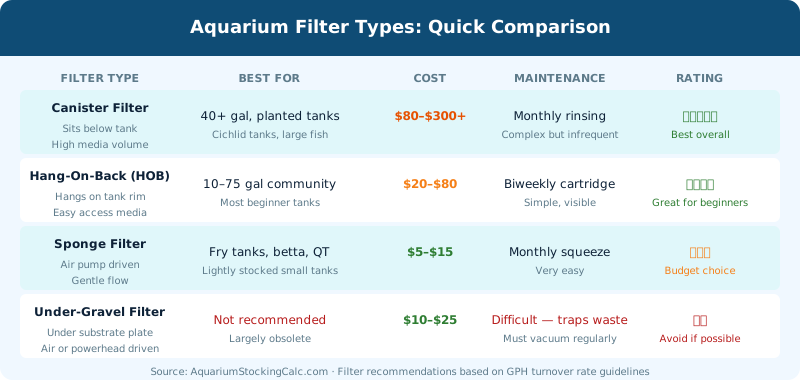
Your filter is the most important piece of equipment in your aquarium, more critical than the heater, the lights, or the décor. Without adequate filtration, fish waste accumulates as toxic ammonia, and the tank crashes. With good filtration, even a heavily stocked tank can stay stable through minor neglect.
Choosing the right filter comes down to three things: filter type, flow rate, and media capacity. Here's what you need to know.
Filter Turnover Rate: The Most Important Number
Filter turnover rate is how many times per hour your filter processes your tank's full water volume. A 55-gallon tank with a filter rated at 165 GPH (gallons per hour) has a 3× hourly turnover. This is the industry benchmark for adequate filtration.
Minimum recommended turnover rates: - Lightly stocked community tank: 3–4× per hour - Moderately stocked tank: 4–6× per hour - Heavily stocked or high-bioload fish (cichlids, goldfish, oscars): 6–10× per hour - Planted low-tech tank: 3–5× per hour (excess flow disturbs CO2)
For a 55-gallon community tank, you want a filter rated for at least 165–220 GPH. Most budget HOB filters marketed "for 55 gallons" are rated closer to 200–300 GPH, which is adequate for average stocking.
Note: Filter ratings are measured without media resistance. In practice, fully loaded filter media reduces effective flow by 20–30%. A filter rated at 200 GPH may deliver 140–160 GPH in actual use. Size up when in doubt.
The Four Main Filter Types
Hang-On-Back (HOB) Filters
HOB filters are the most popular choice for tanks up to 75 gallons. They hang on the tank's back wall, pull water through a siphon tube, filter it through media cartridges, and return it via a waterfall. Setup is simple, media changes are visible and easy, and they're reliable.
Pros: Easy to set up, easy to maintain, good for beginners, widely available, affordable ($20–$80).
Cons: Limited media capacity compared to canister filters at the same flow rate; the waterfall return adds surface agitation (good for oxygenation, bad for CO2-injected planted tanks); can't be positioned below tank level.
Best for: Tanks 10–75 gallons, community fish, beginners.
Canister Filters
Canister filters sit below the tank in the cabinet, pulling water down through intake and return tubes. They hold far more biological and mechanical media than HOB filters at equivalent flow rates, making them the choice for heavily stocked tanks and large setups.
Pros: Larger media capacity, versatile media options, quieter operation, good for large tanks, excellent for planted tanks (low surface agitation).
Cons: More complex setup and maintenance, higher cost ($80–$300+), require priming when restarting.
Best for: Tanks 40 gallons and up, heavily stocked systems, planted tanks, cichlid tanks, large fish.
Sponge Filters
A sponge filter is an air-driven device: a sponge on a tube driven by an air pump. Water passes through the sponge, where bacteria colonize the dense foam. Simple, cheap, and extremely effective at biological filtration. Poor at mechanical filtration.
Pros: Very cheap ($5–$15), silent if run from a quiet air pump, gentle flow (good for fry and small fish), excellent bacterial surface area, easy to clean.
Cons: Minimal mechanical filtration (can't trap fine particles), aesthetics, require separate air pump.
Best for: Quarantine tanks, fry tanks, betta tanks, lightly stocked small tanks, as supplemental filtration alongside a canister.
Internal/Submersible Filters
Small filters that sit inside the tank on a suction cup. Compact, simple, and inexpensive. Most are underrated for their size and work fine in small tanks up to 20 gallons.
Pros: Low cost, simple setup, submersible.
Cons: Limited flow rate and media capacity, visible in tank, harder to access for maintenance.
Best for: Tanks under 20 gallons, quarantine setups.
Mechanical, Biological, and Chemical Filtration
Good filtration addresses three separate functions:
Mechanical filtration traps solid particles: fish waste, uneaten food, and plant debris. This is typically a foam sponge or filter floss in the first stage of your filter. Clean it every 2–4 weeks, as a clogged mechanical stage blocks flow and increases ammonia.
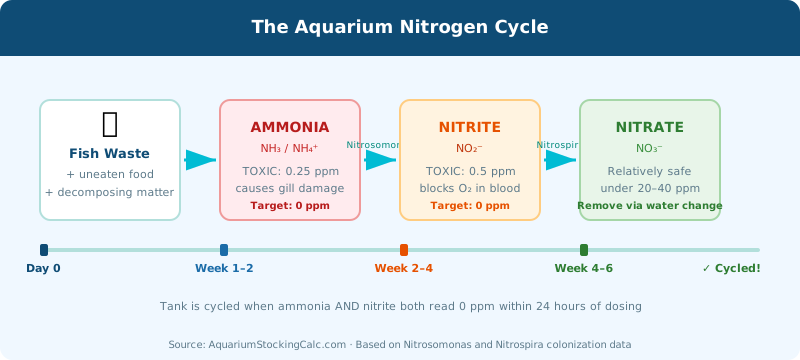
Biological filtration is where the real work happens. Porous media like ceramic rings, bio-balls, or lava rock host the nitrifying bacteria that convert ammonia to nitrite to nitrate. This media should never be cleaned in tap water (chlorine kills bacteria). Rinse only in dechlorinated water or old tank water if visibly fouled.
Chemical filtration (usually activated carbon) removes dissolved organics, tannins, and some medications. Useful but not essential for most community tanks. Carbon needs replacing every 4–6 weeks or it stops working. Skip it in tanks where you're using liquid plant fertilizers; carbon absorbs them.
Sizing Your Filter: A Practical Guide
Here are filter sizing recommendations by tank volume and stocking intensity:
| Tank Size | Light Stocking | Moderate Stocking | Heavy Stocking |
|---|---|---|---|
| 10 gallons | 30–50 GPH | 40–70 GPH | 60–100 GPH |
| 20 gallons | 60–80 GPH | 80–120 GPH | 100–200 GPH |
| 29 gallons | 90–120 GPH | 120–175 GPH | 150–290 GPH |
| 55 gallons | 165–220 GPH | 220–330 GPH | 275–550 GPH |
| 75 gallons | 225–300 GPH | 300–450 GPH | 375–750 GPH |
| 100 gallons | 300–400 GPH | 400–600 GPH | 500–1000 GPH |
For high-bioload fish like goldfish, oscars, or a heavily stocked cichlid tank, use the high-stocking column and consider running two filters for redundancy.
Filter Maintenance Schedule
Even the best filter underperforms when neglected. Here's a basic maintenance schedule:
- Every 2–4 weeks: Rinse mechanical media (filter floss, coarse sponge) in old tank water during a water change
- Every 3–6 months: Rinse biological media in old tank water if visibly clogged. Do NOT rinse in tap water
- Every 4–6 weeks: Replace chemical media (activated carbon) if using it
- Yearly (canister): Inspect and replace impeller, intake strainer, and output nozzle O-rings
The nitrogen cycle guide explains why biological media maintenance is so important. Losing your bacterial colony resets your tank to uncycled status.
What Filter Do You Actually Need?
If you're stocking a community tank and want to know whether your filter is adequate, the key question is: what's your stocking level relative to your filter's rated output? Our aquarium stocking calculator lets you adjust filtration quality as an input; changing from "average" to "excellent" filtration increases your recommended fish count by 20–30%.
For most 20–55 gallon tanks, a quality hang-on-back filter rated 3–5× turnover with a separate sponge filter as backup covers most stocking scenarios. For anything with large, high-bioload fish, step up to a canister filter and aim for 6–8× turnover.
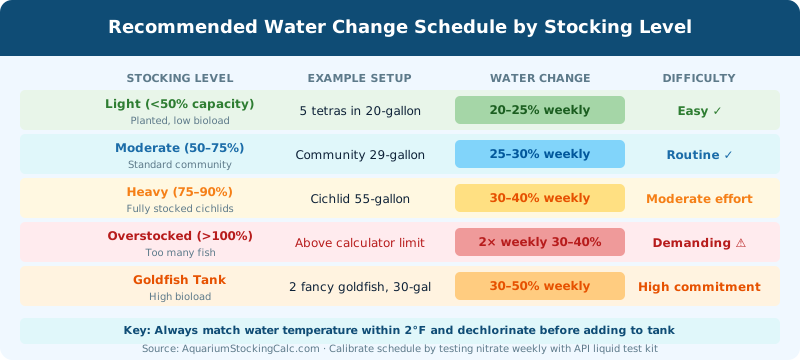
Check our water change schedule guide for how filtration strength affects your maintenance frequency.
AquariumStockingCalc Team
We build accurate, science-based aquarium calculators for hobbyists and professionals.
Related Guides
The Nitrogen Cycle: Why It Matters Before Adding Fish
The nitrogen cycle converts toxic ammonia into safer nitrate via beneficial …
7 Signs Your Aquarium Is Overstocked (And How to Fix It)
Cloudy water, fish gasping at the surface, frequent disease: these are class…
How Often Should You Change Aquarium Water? A Science-Based Guide
Most aquariums need a 25–30% water change weekly. But the right frequency de…